Memories of Himeyuri and Ryukyu-shikki
May 21, 2012
Having lived in Japan for four years it is difficult for me to single out one day as my “best day” in Japan. My day-to-day life was lived in Okinawa. Okinawa, though legally and politically part of Japan, is in many ways a different country where the people happen to speak Japanese. While in Japan I did take five trips to see “mainland Japan” and while talking about those trips might be interesting and certainly more lighthearted, I feel it does a disservice to ignore the people and places of the island which formed the core of my Japan experience.
I’d been on the island less than six months and aside from a few business trips into Naha and one foray up to Nago, I’d seen very little of the island. I met a friend on a pen pal site online, Rina, who worked in the local tourist industry as many people do. She spoke English as well as Japanese which helped smooth things over. She was from Kochinda, a town on the southern end of the island. One weekend day she suggested a trip south. “We will go to Himeyuri monument,” she said.
I knew Okinawa had been the site of a horrific battle in WWII. We would also visit the Peace Prayer Park that day and the very excellent museum there. But the word himeyuri meant little to me beyond the obvious translation “princess lily”. After a drive of two hours, we arrived at a small park like place situated between the usual tourist shops filled with shisa and beni-imo tarts and Ryukyu glass oddly made in Vietnam. My friend explained to me that several hundred nursing students had died in the caves there during the battle and this was a memorial. Given the ferocity of the battle I would not have been surprised if the entire island was covered with memorials to the war, and it is.
My father is something of an amateur historian, and WWII is a favorite field of study. So, I’ve seen museums on the subject in the US, and later I would see the museum at the controversial shrine of Yasukuni in Tokyo. Each tells the same history with a slightly different perspective. What is different about Okinawan war memorials is that history is not told from the perspective of the victors, nor the conquered, but the victims. When you round the gaping hole of the cave entrance where so many once took shelter and enter the museum, there is little discussion of the weaponry, or strategy used by the opposing Japanese and American forces.
The “nursing students” were not volunteers, they were high school students the same age as the ones I was teaching, who were conscripted into serving in the Japanese army hospitals and then abandoned to the battlefield when the situation became hopeless. The museum cases are filled with pieces of their uniforms, school pictures, sewing kits and small mementos of happier times that they brought with them and were later found in the caves where most of them died.
As I said, the memorial is located in what has become a strip of tourist development along the major route around the southern tip of Okinawa. Less than 1 km down the road, I spotted a building decorated with an enormous flower hat, the type worn by Okinawan court dancers when the island was an independent kingdom.
I asked to stop and Rina obliged. It was a shop of Ryukyu-shikki, or Okinawan lacquer ware. Maybe you are familiar with the type from Kyoto. The Okinawan style is more garishly colored and covered in stylized native flowers, like the hibiscus. As we walked up and down the aisles of brightly colored bowls and bento boxes, my friend Rina explained to me. “Only old people buy this now; young people don’t like this style anymore,” I thought about the young Japanese people I knew in their tiny ikea-inspired minimalist apartments, and understood what she was saying, but I thought it was beautiful. Later, I became a very good patron of the Naha branch of the shop. I think the shopkeepers always remembered me because I was their only Japanese speaking foreign client. The stuff is expensive because it is labor intensive and handmade and I couldn’t always afford to buy much more than chopsticks or a hairpin, but I felt it was important of me to patronize the shop. I always wonder if I go back will it still be there with the shop ladies serving sanpin-cha and small bricks of the black cane sugar to their customers.
The last stop on our southern adventure was Seifa-Utaki, a sacred site both during the present and the Ryukyu Kingdom. Because of the battle there over 65 years ago, very little of Okinawan material culture survives. The castles and other “historic sites” tourists are led to are all very carefully restored reproductions. All that stands at Seifa-Utaki are rocks. The rituals performed there during the Ryukyu kingdom are largely forgotten, but Rina thought it was important to take me there.
With a large part of their material culture destroyed during the war, Okinawa of the present and the future is largely built on memory, the memory of those who survived, and won’t forget. One of the great experiences of travel is to discover how we define ourselves as people by what we chose to remember, and what we chose to forget.
Acid Reflux and other digestive issues have finally forced me to give up chocolate for good, it seems…. Oh woe is me, what am I to eat when I get that sweet thing craving. Oddly enough white chocolate that is not contaminated by wheat is relatively difficult to find. Given that we just passed through Easter season, believe me I tried.
Another pet peeve of mine is Ben and Jerry’s, so many of their flavors have either cookie bits or chocolate in them that I’m left eating vanilla and pistachio, assuming that your can find either of these relatively blah flavors at your local store. B&J has built a business catering to people who want goobers of stuff in their ice cream.
Can you imagine my elation when I found an ice cream product just as good as B&J, but most of its flavors are marked GF. I’d seen Talenti Gelato at my local organic grocer haunts for some time. the only reason I did not try it sooner was the $6 a pint asking price, $2 more than B&J. A $4.49 sale on pints at Healthy Living got me started. True to Italian ice cream tradition, the texture is softer than B&J and easier to stick that spoon into. The first flavor I tried was their Sicilian Pistachio. It’s good. But by far my favorite is their Caribbean Coconut. Try it heaped with fresh raspberries and you’re in for a real special treat. Their strawberry is decent as well.
Glutino is really a mixed bag brand as far as replacement food go. A few things are good, a fair number are “meh”, and an equal number rare far inferior to other products out there. How they became the “General Mills” of GF replacement foods is beyond me except they may have gotten there before everybody else jumped on the GF bandwagon.
One of their products that is worth a try are their yogurt covered pretzels. Yes, they have chocolate covered ones too, but for the choco-deprived they are heaven if you are looking for a guilty sweet snack. Health food this is not.
Happy midnight snacks, GF folks.
It Hasn’t Begun (poem)
March 9, 2012
Sometimes I feel as if
Life hasn’t begun yet.
Hasn’t begun, and all the
Small joys and rewards
Will evaporate, like dew on the grass.
Sometimes I feel as if I should
Struggle for it.
As if I should struggle…
To live.
To live… life, to its fullest… capacity,
And I…
Am exhausted.
Cracked Diamond (original flash fiction)
March 9, 2012
Cracked Diamond
I had the ring in my hand. There’d been questions before and I guess I thought that the ring would just help cement things. But then I saw the guy with her through the plate-glass window of the café and knew it was not to be.
I didn’t even have the heart to confront her. At least that way I could go on pretending maybe it was all just one big misunderstanding (in my imagination at least). Maybe he was a cousin, or a long-lost brother and that embrace was a gesture of friendliness not genuine attraction.
That night, when I was sure no one was looking, I went down to the docks and had myself a good scream. The lights on the wharf flickered.
When all was said and done, I looked down into my hands.
Her diamond had cracked.
Never…Never again… I’m just not getting married, I promised myself, and slipped off into the darkness.
Frontier Soups and My Favorite Boxed Soup Stock!
March 3, 2012
One of my best GF discoveries since returning Stateside have got to be Frontier Soup kits. Not all their kits are – but a fair number are (they contain the usual warning about not being made in a dedicated GF facility). The first I tried and by far my favorite is the Wisconsin Lakeshore Chicken and Wild Rice Soup. -Yum! All you will need to feed 4-6 is one soup kit, 2 boxes of chicken stock, 3 chicken breasts, a modest bag of peas and carrots, and a few tablespoon of olive oil, follow the directions and -voila, the yummiest chicken soup ever. There is a variation in the recipe on the back of the package that calls for white wine; I must confess I like it so much as is I’ve never tried it, but I’m sure its delicious. One warning, the wild rice takes forever to cook and tends to remain chewy. It won’t get mushy, so throw it in as soon as you add the broth. The kit also comes with GF corn noodle spirals. they hold up pretty well, but as with any Gf pasta add them last, as in 5-10 minutes before you plan on serving the soup.
My favorite boxed chicken stock to use with this recipe and anything else has got to be Kitchen Basics Unsalted Chicken Stock. It has a nice flavor, no MSG taste, and since its unsalted you can choose your own level of seasoning. I like to brown my diced chicken breast separately in a little olive oil and salt/pepper before adding to the soup.
I’ve been making the chicken and wild rice soup about once a week, so I was excited to find another Frontier Soup kit for French Onion Soup. The kit is GF. And if you add only GF items you should be safe, unlike at restaurants where said soup is usually served with a piece of bread floating in it. I also happen to be intolerant/allergic to beef and this soup is suggested to be made with beef stock, as is traditional. I’m happy to report it’s quite passable with aforementioned chicken stock. I even added a little GF beer to “beef it up” so to speak. You’ll need 1-2 onions and 1/2 cup apple cider to complete this soup, plus cheese and some GF bread or croutons as a topping. Toast your GF bread separately and put it on just before serving so it doesn’t get too soggy too fast. This might be a good use for those chewy, crusty Udi’s bagels, although I had mine with Schar Ciabatta Par-baked Rolls.
Peamut Butter Cookie Wars
February 10, 2012
One of the first specifically GF replacement products I tried were Pamela’s Peanut Butter Cookies that I bought in Seattle at Whole Foods. By then I hadn’t had anything closely resembling bread or cookies in about 3 months, as such replacement products by and large simply don’t exist in Japan. I was so desperate for sweet carbs aside from mochi that I didn’t realize quite how good they were, until I recently tried a competing pre-packaged GF cookie product by Tree of Life. Now, I can tell you with certainty that Pamela’s has the packaged GF cookie market won (at least as far as nationally available products go).
GF replacement products are usually expensive enough that when it comes to non-essentials, like sweet treats, I confine myself to sales and weekly specials. I had bought some Tree of Life shortbread cookies and found them okay, so when the peanut butter ones came on sale I figured they ought to be good, -wrong… Of the typical problems GF baked goods face, these have it all: dry, gritty sandy and so crumbly I think only half the cookies in the package were intact. Of course this could have been why they were on sale. While a certain amount of sandy texture is the nature of shortbread, it is totally unacceptable in peanut butter cookies, especially when such a good alternative exists.
Pamela’s PB cookies are moist and chewy and have none of the gritty sandy-ness that often plagues GF replacement foods. To Tree of Life, I can only say “Try, try again…”
The Story of the Lucky Cat
January 28, 2012
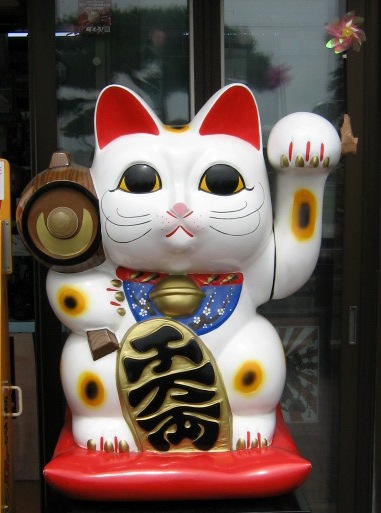
A very long time ago, or as they say in Japanese, “Mukashi, mukashi….”, A wealthy samurai found himself caught outside in a rain storm. He took shelter under the nearest tree.
This tree grew outside the doors to a small local temple. The monks of the temple were poor and did not have much money for its upkeep, including taking care of the cats, who had to fend for themselves by hunting mice who ate the offerings brought to the temple as well as the monks’ food.
Standing under the tree, the samurai thought he could see one of the temple cats beckoning to him from the gates. The man thought to himself, “That looks like a friendly cat, and I have nothing better to do but sit here and wait for the rain to stop. It would be okay to get a little bit wet in order to go over there and pet that nice cat.”
So, the samurai gathered his things and walked through the rain to the door of the temple where the cat sat waiting for him. No sooner had he reached down to pet the cat, than a giant bolt of lighting shot down from the heavens and stuck the tree where he had been sitting. The tree was engulfed in fire.
The samurai stood there for a moment silently watching the tree burn, and contemplated his avoided fate before speaking to the cat, “How lucky is was that I saw you beckon to me, for had I remained where I was I would surely be dead now,”.
“Meow!” said the cat.
“You truly are a cat of good fortune,” he said, “Since you saved my life, a debt which is impossible for me to repay, I will do everything in my power to make your life easier,”.
True to his word, the samurai used his fortune to endow the temple, so the monks were not so poor anymore, and the cats no longer had to fend for themselves. And when the lucky cat finally died of happy old age, the samurai paid for a proper funeral and memorial to the beloved “lucky cat” who had saved his life.
Generations of cats at the temple benefited from the samurai’s generosity and it is said that the cat who saved his life was actually an incarnation of the Buddist goddess of compassion, Kwan-yin.
Story notes:
According to one version of the story, the events in question took place at Goutoku-ji Temple, and the samurai was Li Naotoka.
This story is said to be the origin of the figures of “maneki neko” commonly found in businesses around Japan. Cats with their right paw up beckon money, left paw-customers. Black maneki neko are particularly in favor with women because they are said to drive away stalkers.
Dedicated to “Midori” the squeaky cat who got left behind while I was in Japan, and to “Aya” the Japanese cat who came back with me…
The JET Thing: my arrival journal 2007
January 28, 2012
For anyone who has ever wondered about what its like joining the JET Programme, or picking up everything and moving to a very foreign country, here’s the journal I kept of my first week in Japan four years ago…
July 26 2007:
Left home in Vermont, the only time I came close to crying was when I gave my goodbye petting to my cat Midori. She was sleeping in a ball on the spare bed in my youngest brother’s room, blissfully unaware of what was really going on. Her biggest concern was that my aunt, who had come to visit, had brought her geriatric 19 year old cat Sasha to visit. Midori thinks that all cats want to be her friends, but Sasha is not a friendly cat.
Mom baked an apple pie at the last-minute, stuffed it in the car and drove it to Albany with us where we had lunch, pie and Ben and Jerry’s Ice Cream. Felt kind of like the last supper.
July 27, 2007:
My aunt and I lugged my heavy bags to the Amtrak station to take the train to NYC. I would be staying my last night in the US with a new friend I met at one of the pre-departure activities. I arrived at Christine’s apartment to discover that she also had a cat, Malka, whom she was leaving behind with a roommate. Another round of suppressed tears… It did not help any that Malka was also a love bug.
Orientation: received our flight tickets and everything. They threw a big farewell reception for us at the Japanese Ambassador’s residence. I lived in NYC for 2 years and always wondered what the inside of those ultra-expensive townhouses near 5th Ave. really looked like on the inside, now I know…
There are a lot of rumors about JET application and acceptance rates. At orientation we gleaned a bit of info: Of about 420 applicants to the NYC consulate only 123 were accepted. I met the nice Japanese lady who took part in my interview, she said that of all the interviews she did that day, only 3 (myself included) did her group recommend.
July 28 rented a car to JFK. Christine and I would be separated by flights. She was on an American Airlines flight and I was going JAL. The last-minute departure mystery was why the JAL tickets cost $1800+ while the American ones cost only about $875. Apparently back in the day they used to fly all the JETS over business class. Not anymore.
Bad case of vertigo on the flight for about 1 hour. 13.5 hours of torture. Decent food though, and the game console made things better.
July 29, 2007:
Arrived in Tokyo 3:30pm. Eight or nine hours disappeared into the oblivion of time change. Susan and I, we were both going to Okinawa, roomed together. We went to our room and passed out at 4pm Tokyo time. I awoke at 3:30am. Would repeat this pattern the whole time I was in Tokyo.
July 30, 2007:
Orientation: they served us Western style food for breakfast. Everyone was asked to assemble in one of the ballrooms to listen to the opening speeches given by government big-wigs. We assembled at 10am. The visiting dignitaries arrived at 11am. Clearly they told us to be there so early so no one had to suffer the embarrassment of having us Americans, etc… show up late.
All the prefecture JETs got together for a night out drinking at a local restaurant. Restaurant theme was “Hell” or “jigoku”. It was an all-you-can-drink for 2 hours. After 2 rounds they gave up on us and brought big pitchers of Kirin over. What do you expect with an Irishman, a Scotsman, a South African and a Kiwi?
July 31st more orientation.
August 1, 2007:
Boarded a bus for Haneda airport to take the plane to Naha, Okinawa. The municipal JETS got greeted at the airport by small crowds of people with signs and cheers. Our tight-knit group of 2 days was being split up it seemed permanently. Some of the participants had been placed on remote outer islands. Okinawa was not my 1st 2nd or 3rd choice place to go, but I was glad I was going to be living on the main island.
The prefectural JETS, those of us placed in senior high schools or BOE offices (there was only one) were handed a cold beer and taken to the local hotel or youth hostel to spend the night and have more orientation. The hotel was dingy and hot! There is air-con almost everywhere here but it does not make the rooms cool. Because the outside temp is like 90F and the locals have a very skewed idea of what constitutes “cool”.
August 24,2007
Japan was the last country I would have ever thought I was going to be learning to salsa dance in, but there I was at 1am taking lessons from a E. Indian-Canadian fellow JET named Kadija.
August 26, 2007
It’s Okinawa Obon. Dates are slightly different from the mainland. I do not have to go to work tomorrow. The grocery stores were busy with people buying those pre-packaged gift things that are at the front of every store here. Also the stores have a very nice selection of little mochi tea cakes and pastries out for sale. I have discovered that anything with anko on the inside is my friend!
On the way home I took what I thought was a shortcut. I wound up in some small back alley with a lot of single family homes and apartment buildings. It was dark so I could see inside. It seems this weekend is a time for families to gather together. I could see groups of people from children to obaasan and ojiisan gathered around tables watching TV. There were lots of cars outside the houses.
It seems nice but I felt suddenly lonely, as if I was missing out.
That was only my second disappointment for the day. I took the bus down to Plaza House. They were all out of JLPT test applications.
Ginseikai
January 28, 2012
Originally written 6/30/2008
I learned a new word yesterday, “ginseikai”. I was practicing the kanji for silver and this rather interesting reading popped up. It literally means “silver world”, but is used to describe a landscape covered by ice or snow. A more accurate description of my home state than its actual name of “Vermont” orGreen Mountains. Vermont is only really green from late May through mid September. And there’s the very real possibility that it can be entirely covered in snow from late October to early April.
Speaking of snow, I can’t believe it’s been over a year since I’ve seen the stuff. Or that the vast majority of my students and colleagues here on Okinawa have never seen it! Okay, there are some things I don’t miss –like driving through it, or leaving the house when it’s minus 20 degrees outside. But growing up in and living my whole life the northern latitudes, its something that I’ve come to take for granted. Something that Okinawa is seriously lacking. And my world seems strange without it.
When one of my students or colleagues here tells me they’ve never seen snow, I usually respond by telling them they should travel. Not necessarily as far as America. Japan being a country of almost infinite latitude, finding things like fluffy white ice crystals is as simple as a long weekend and a 4 man airplane ticket to the snow festival in Sapporo.
 etaindesigns